Wildfire is making homes uninsurable. Calyx is the hardware that makes them defensible again.
An automatic, built-in defense system that senses wildfire, deploys in under two minutes, and shrouds the home in a water-cooled curtain. We're building the category of active home hardening, the missing lever between a burning map and an insurable home.
46 million homes are now in the line of fire.
For three decades, American building pushed into the wildland. The fuel, the heat, and the houses now overlap, and it's the embers running ahead of the flame front, not the wall of fire, that ignite most of them.
U.S. homes at significant wildfire risk
Headwaters Economics · NFPA
Communities exposed to wildfire
NFPA
Of homes built since 1990 sit in the wildland-urban interface
Headwaters Economics
The people who price risk are pulling out.
Carriers are non-renewing fire-country policies, and the state insurer of last resort is absorbing the overflow at an unsustainable rate. Insurability is becoming the gating factor for owning, and selling, a home in the West.
California FAIR Plan exposure (insurer of last resort, Mar 2026)
CA FAIR Plan
Growth in FAIR Plan exposure since 2021
CA FAIR Plan · AM Best
FAIR Plan policies vs. 2020 as insurers retreat (684K in force)
CA FAIR Plan
Hardware that measurably reduces structure loss is the missing lever between this retreat and a functioning market.
January 2025 made it undeniable.
The Palisades and Eaton fires tore through dense suburban Los Angeles, not remote forest, and became among the costliest wildfire events in U.S. history. Demand for real home defense is no longer hypothetical.
Structures destroyed (Palisades & Eaton fires)
Cal Fire
Estimated total economic impact
AccuWeather
Insured losses, among the costliest wildfires on record
Verisk · CA Dept. of Insurance
Built-in. Automatic. Already engineered.
Calyx installs on the home like a structural system. When wildfire approaches, it senses the threat, raises a set of telescoping towers, and deploys a water-cooled perforated curtain that shrouds the structure, blocking direct flame and the ember storm that precedes it. No one has to be home. No one has to be brave.
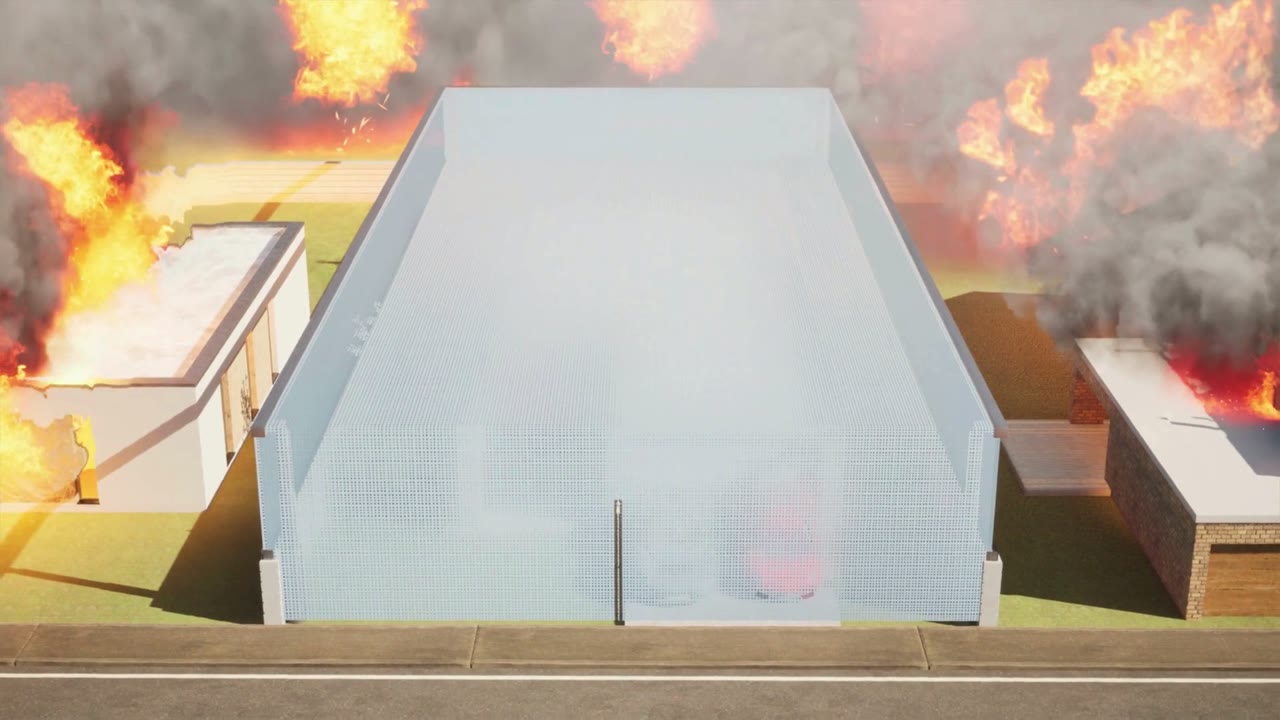
- Deploy time
- under 2 minutes
- Coverage
- 360°, 5 ft above roofline
- Wind rating
- withstands 80 mph
- Curtain
- water-cooled perforated fiberglass
- Defense
- blocks direct flame contact
- Power
- battery backup, grid-independent
A new category inside a multi-billion-dollar shift.
Active home hardening, engineered systems that defend a structure in real time, is an emerging subset of a wildfire-protection market already measured in billions and growing at a double-digit clip. The wedge is insurer alignment: a system that lowers loss is a system that protects premiums.
Wildfire protection systems market, 2024 (firm estimates span ~$2 to 10B)
Market Research Intellect
Projected within a decade (~8 to 13% CAGR)
Multiple market sources
Insured exposure seeking a way to stay covered (CA FAIR Plan)
CA FAIR Plan
Market-size estimates vary by source and definition; figures are directional, with methodology in the full brief.
What fire country can buy today.
Today's defenses ask for a person, a warning window, or a working water main. Crews staple wraps on by hand, gels dry out in fire weather, and sprinklers draw on mains that fail when a whole town opens them at once. Each one helps. None is an automatic physical barrier around the home.
Exterior sprinklers
App-triggered or sensor-automatic
Wets the structure and 30 to 40 ft around it
Wetting, not a barrier — and it leans on sustained water flow exactly when hydrants fail. Roughly 1 in 5 ran dry in the Palisades Fire.
Retardant gels & coatings
Sprayed by hand, hours to a season ahead
Treated vegetation and wood surfaces
Dries out up to 10× faster in fire weather, needs re-wetting that conflicts with evacuation, and works once.
Structure wraps
Crew-installed over most of a day
The wrapped structure only
Rated for a fire front that passes in minutes, single-use, and the lot around the house stays exposed.
Passive hardening
Always on — roofs, vents, defensible space
Lowers the odds of ignition
Proven and worth doing — but it can't respond to the fire. CAL FIRE's own words: "not a guarantee."
Calyx
Patent pendingAutomatic — on-site sensors or remote trigger, battery-backed
A water-cooled physical barrier enclosing the whole lot
Engineered to close every gap above. Patent pending, in development.
Characterizations are category-level, drawn from vendor-published product information and independent reporting as of mid-2026; sources are compiled in the full brief. Strong products exist in every category, and several activate automatically. What none offers is an automatically deployed physical barrier enclosing the whole lot — that combination is what Calyx is engineered, and filed, to be.
Why this wins.
Automatic, not heroic
Patent-pending autonomous deployment. The system acts at the worst possible moment, so no one has to be home, or brave, to defend the house.
Built for the real failure mode
Most homes don't burn from the flame front. They burn from wind-driven embers hours ahead of it. Calyx is engineered to shut out the ember storm, not just the wall.
Aligned with the payer
The rails already exist: California mandates insurance discounts for hardened homes (Safer from Wildfires, 2022), and carriers from AIG to Chubb fund private defense crews during fires. Measurable structure-loss reduction turns insurers from gatekeepers into a distribution channel.
What we're raising to do.
We're moving Calyx from working prototype to first installations. Round size, terms, and detailed financials live in the full investor brief. Request access below.
Manufacturing & supply
Tooling and the path to producing the system at install-ready volume.
Certification & testing
Independent fire, wind, and durability validation toward code acceptance.
First installations
Initial homes in high-risk markets, proof points for insurers and buyers.
Founder-led, building in the open.
Calyx is led by its founding team, with a working prototype and patent filing already in hand. Full backgrounds, advisors, and references are included in the investor brief.
Want the full picture?
Request the complete investor brief (round details, financials, traction, and team) or just reach out directly.
contact@calyx.homesThis page describes a product in development and a company's plans; renderings and specifications illustrate intended design and may not reflect final performance. Nothing here is an offer to sell or a solicitation of an offer to buy any security, and market figures are drawn from the third-party sources cited above. Any investment is offered only through the full brief and definitive documents.